

Custom Injection Molding for Industrial Equipment & Large Parts | Structural Foam vs Injection Molding Guide
Custom Injection Molding is one of the most efficient and scalable manufacturing processes for producing high‑precision plastic components across industrial sectors. From industrial machinery housings to large automotive structural panels, custom injection molding enables manufacturers to achieve dimensional stability, repeatability, and cost‑effective mass production.
At Huawei Product Development Industrial Ltd, we specialize in prototype injection molds and production molds, providing end‑to‑end manufacturing solutions including industrial design, prototyping, mold fabrication, injection molding, and OEM production. With over 30 years of experience in automotive structural parts and high‑precision industrial components, we help global customers reduce development risks and accelerate time‑to‑market.
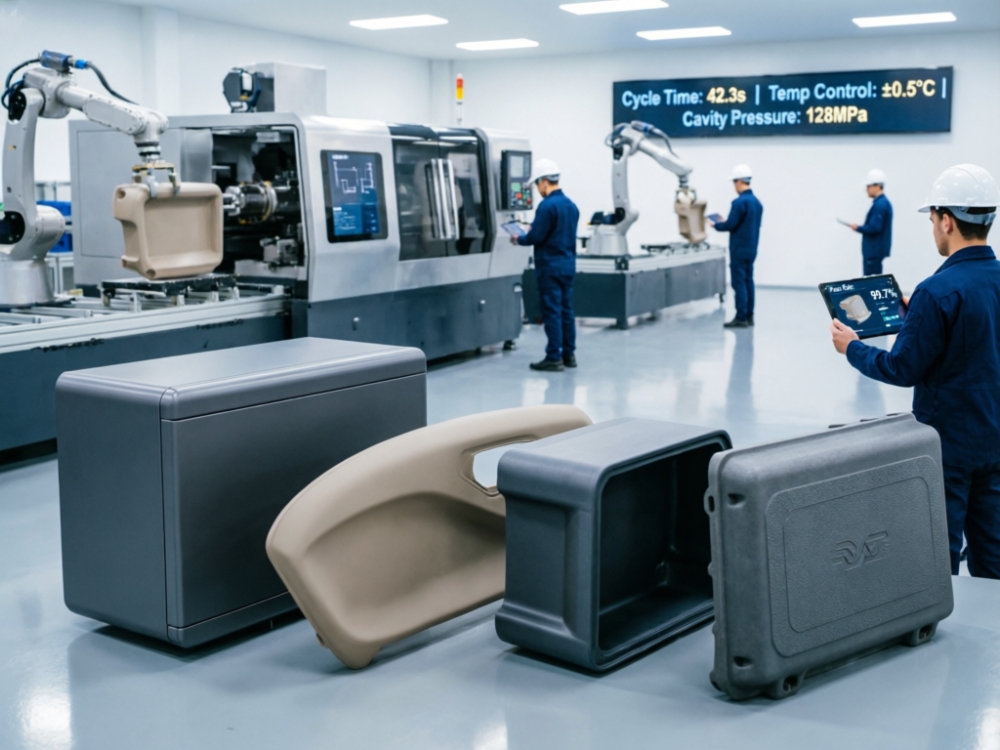
In this comprehensive guide, we will explore:
- Injection molding for industrial equipment
- Large part custom injection molding
- Structural foam vs injection molding
Table of Contents
- Injection molding for industrial equipment
- Large part custom injection molding
- Structural foam vs injection molding
- Integrated Custom Injection Molding Services
- Advantages of Choosing Our Custom Injection Molding Services
- FAQ – Custom Injection Molding for Industrial Applications
- Start Your Custom Injection Molding Project Today
Injection molding for industrial equipment
Injection molding for industrial equipment is widely used in manufacturing structural housings, control panels, protective covers, enclosures, and functional mechanical components.
Industrial equipment manufacturers demand:
- High precision
- Mechanical durability
- Chemical resistance
- Long service life
- Stable dimensional tolerance
Custom Injection Molding allows complex geometries to be produced with consistent repeatability, making it ideal for industrial machinery components such as:
- Printer and copier housings
- QA inspection equipment parts
- Communication device enclosures
- Automation equipment structural components
- Instrument casings
- Control system panels
Huawei Product Development focuses on high‑precision structural parts used in equipment for medical and communication industries, as well as industrial precision machinery.
Technical Requirements of Custom Injection Molding for Industrial Equipment
| Requirement | Description | Engineering Solution |
|---|---|---|
| Dimensional Accuracy | Critical for assembly compatibility | High precision mold machining |
| Load Bearing Strength | Support structural components | Reinforced rib design |
| Heat Resistance | Exposure to motor heat | Engineering plastics (ABS, PC, PA) |
| Chemical Resistance | Industrial solvents exposure | Proper resin selection |
| Long-Term Durability | Continuous operation environments | Mold flow optimization |
Role of Prototype Injection Mold in Industrial Equipment Development
For new industrial equipment projects, companies often face uncertainty regarding design feasibility, resin flowability, and injection stability.
Building a prototype injection mold provides the following advantages:
- Test and verification of plastic parts design
- Test and verification of mold design
- Test and verification of resin flowability
- Functional performance validation
- Short lead time market testing
At Huawei Product Development, prototype injection molds maintain the same precision level as regular molds. This allows customers to use the exact same plastic material planned for mass production while saving overall development costs.
After design optimization, prototype molds can be upgraded into production molds, minimizing tooling waste and investment risk.
Large part custom injection molding
Large part custom injection molding refers to the production of medium and large-sized plastic components such as automotive interior panels, machine housings, and structural shells.
Manufacturing large injection molded parts requires:
- Advanced mold design
- Controlled injection pressure
- Optimized cooling systems
- Balanced resin flow
Huawei Product Development is a professional medium and large-scale mold manufacturer in China, with over 30 years of experience in automotive molds and plastic auto parts.
We manufacture molds for:
- Automotive door panels
- Instrument panels
- Bumpers
- Grilles
- HVAC system components
- Engine peripheral parts
- Medical equipment housings
- Smart device enclosures
Challenges in Large Part Custom Injection Molding
| Challenge | Description | Engineering Approach |
|---|---|---|
| Warpage | Uneven cooling in large surfaces | Mold flow analysis |
| Sink Marks | Thick wall sections | Optimized gate design |
| Material Flow Imbalance | Long flow paths | Multi-gate system |
| Structural Weakness | Large unsupported areas | Rib reinforcement |
| Tooling Cost | Large mold base investment | Prototype-first strategy |
Prototype Strategy for Large Plastic Parts
For large structural parts, tooling investment can be significant. Therefore, adopting a prototype injection mold strategy is highly recommended.
Benefits include:
- Reduced financial risk
- Early design validation
- Faster lead time
- Small batch production for market testing
- Opportunity to modify before final production mold
Because our prototype molds achieve the same accuracy as production molds, clients can confidently test functionality and performance before scaling up.
Structural foam vs injection molding
When selecting a manufacturing method for large or structural plastic components, many engineers compare structural foam vs injection molding.
What is Structural Foam Molding?
Structural foam molding uses a chemical blowing agent mixed with plastic resin. During injection, gas expansion creates a foam core with a solid outer skin.
Advantages:
- Reduced part weight
- Lower injection pressure
- Ability to mold very thick sections
- Reduced clamp force requirements
Limitations:
- Lower surface finish quality
- Less precision compared to traditional injection molding
- Visible swirl patterns possible
What is Custom Injection Molding?
Traditional Custom Injection Molding injects molten plastic into precision molds under high pressure, producing solid parts with excellent surface finish and dimensional accuracy.
Advantages:
- High precision
- Excellent surface appearance
- Tight tolerance control
- Ideal for complex geometries
- High repeatability
Limitations:
- Higher tooling cost for very large parts
- Higher clamp force requirements
Structural Foam vs Injection Molding Comparison Table
| Criteria | Structural Foam | Custom Injection Molding |
|---|---|---|
| Surface Finish | Moderate | High |
| Dimensional Accuracy | Medium | High |
| Tooling Cost | Lower for large parts | Higher initial investment |
| Weight | Lighter | Solid structure |
| Production Volume | Medium | High |
| Design Complexity | Limited | Complex geometries supported |
| Structural Strength | Good | Excellent |
Integrated Custom Injection Molding Services
1. Engineering Design Assistance
2. Industrial Design
3. Prototyping Services
- 3D printed prototypes
- CNC machined prototypes
- Vacuum casted prototypes
- High‑precision plastic injection prototypes
4. Plastic Injection Mold Services
- Mold Design
- DFM Meeting Procedure
- Mold Flow Analysis
- Prototype Injection Mold
- Aluminum Mold
- Bridge Mold
- Rapid Mold
- Production Mold
5. Injection Molding & OEM Manufacturing
- Short-run production
- Medium-run production
- Long-run production
- OEM parts manufacturing
Advantages of Choosing Our Custom Injection Molding Services
| Advantage | Benefit to Customer |
|---|---|
| 30+ Years Experience | Deep automotive & industrial expertise |
| High Precision Mold Fabrication | Stable dimensional tolerance |
| Prototype + Production Integration | Reduced risk & cost |
| Strict QC System | Reliable delivery |
| DFM & Validation Procedures | Optimized mold performance |
| OEM Manufacturing Capability | One-stop solution |
FAQ – Custom Injection Molding for Industrial Applications
What is Custom Injection Molding used for?
Custom Injection Molding is used to manufacture precision plastic components for automotive, industrial equipment, medical devices, aerospace systems, and smart devices.
When should I choose prototype injection mold?
Prototype injection molds are ideal when developing new products that require design validation, resin testing, and functional verification before committing to full production tooling.
Can prototype molds be converted into production molds?
Yes. After design optimization, prototype molds can be upgraded or modified into formal production molds, reducing tooling waste.
Is structural foam better than injection molding?
It depends on the application. Structural foam is suitable for lightweight, large components where surface quality is not critical. Custom Injection Molding provides better precision and surface finish.
How do you ensure mold accuracy?
We use DFM analysis, mold flow simulation, strict QC systems, and high-precision machining processes to guarantee dimensional stability.
Start Your Custom Injection Molding Project Today
If you are looking for a reliable and experienced Custom Injection Molding partner for industrial equipment, large plastic components, or high‑precision structural parts, Huawei Product Development Industrial Ltd is ready to support your project.
From product design and prototype injection molds to mass production molds and OEM manufacturing, we provide full-link intelligent manufacturing solutions tailored to your requirements.
Whether you need:
- Prototype injection molds for new product validation
- Rapid molds for small-batch production
- High-precision production molds for large-scale manufacturing
- Large part custom injection molding solutions
Our engineering team will help you reduce development risk, optimize mold performance, control costs, and accelerate your market launch.
Email: admin@huaweiproduct.com
Phone: +86-755-8238-2595
Partner with Huawei Product Development — Your Trusted Custom Injection Molding Manufacturer.