

Custom Injection Molding Quality Standards, Certifications & Quality Control Guide
Custom Injection Molding is a precision-driven manufacturing process widely used in automotive, medical, industrial equipment, aerospace, and AI robotics applications. While design flexibility and cost-efficiency are important, quality control and certification compliance ultimately determine whether a custom injection molding project succeeds in global markets.
For industries such as automotive structural parts, medical equipment housings, and industrial precision components, strict quality standards are not optional — they are mandatory.
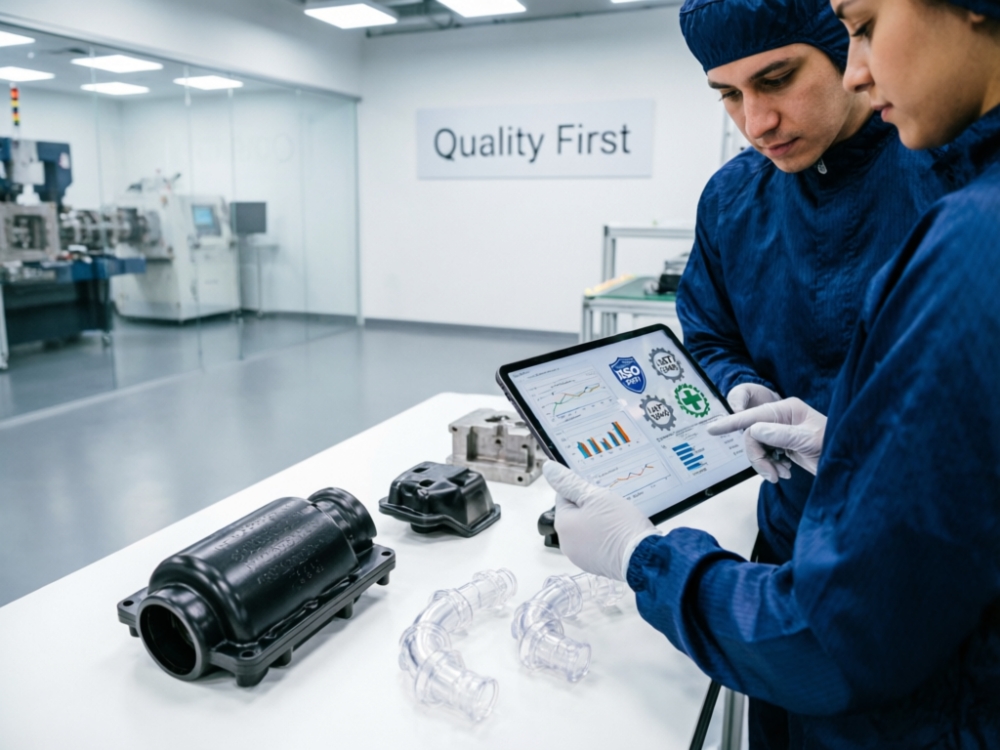
Huawei Product Development Industrial Ltd specializes in prototype injection molds and production molds, with over 30 years of experience in high-precision automotive and industrial applications. Our systematic quality control processes, DFM procedures, and mold validation standards ensure that every custom injection molding project meets international expectations.
In this guide, we will answer the following key industry questions:
- What quality standards apply to custom injection molding?
- How to ensure quality in injection molding?
- What certifications should an injection molding company have?
- Why Quality Matters in Custom Injection Molding for Industrial Applications
- Huawei Product Development: Quality-Focused Custom Injection Molding Partner
- FAQ – Custom Injection Molding Quality & Certification
- Start Your Custom Injection Molding Project with a Certified Quality Partner
What quality standards apply to custom injection molding?
Custom Injection Molding projects must comply with different quality standards depending on the application industry. These standards ensure consistency, safety, dimensional accuracy, and performance reliability.
Below are the most commonly applied standards in custom injection molding:
1. ISO 9001 – Quality Management System
ISO 9001 is the foundational international quality management standard applicable to all manufacturing sectors.
It focuses on:
- Documented process control
- Continuous improvement
- Risk-based thinking
- Traceability
- Customer satisfaction
Any professional custom injection molding manufacturer serving global customers should operate under ISO 9001-compliant systems.
2. IATF 16949 – Automotive Industry Standard
For automotive structural components such as:
- Door panels
- Instrument panels
- Bumpers
- HVAC components
- Engine peripheral parts
IATF 16949 compliance is critical.
This standard ensures:
- Defect prevention
- Reduced variation and waste
- Advanced product quality planning (APQP)
- PPAP documentation
- Strict traceability
Huawei Product Development has extensive experience in automotive molds, serving global automotive brands including Volvo, BMW, Mercedes-Benz, GM, Ford, Volkswagen, Nissan and others.
3. ISO 13485 – Medical Device Manufacturing
For custom injection molding used in medical device housings and equipment:
- Clean production environments
- Material traceability
- Process validation
- Risk management documentation
Medical molding demands extremely high precision and contamination control.
4. Material Compliance Standards
Depending on product destination:
- RoHS compliance
- REACH regulation
- FDA-approved materials
- UL flame-retardant certification
These standards ensure resin safety and environmental compliance.
Summary Table: Custom Injection Molding Quality Standards
| Standard | Industry | Focus Area |
|---|---|---|
| ISO 9001 | All industries | Quality management system |
| IATF 16949 | Automotive | Defect prevention & traceability |
| ISO 13485 | Medical | Process validation & contamination control |
| RoHS / REACH | Global markets | Environmental compliance |
| FDA | Medical & food | Material safety |
| UL | Electrical products | Flame resistance |
How to ensure quality in injection molding?
Ensuring quality in Custom Injection Molding requires control across every stage of the product lifecycle:
- Product design
- Mold design
- Mold fabrication
- Injection molding production
- Final inspection and validation
1. DFM (Design for Manufacturability) Meeting Procedure
Before mold fabrication begins, DFM analysis must be conducted to evaluate:
- Wall thickness uniformity
- Draft angles
- Rib design
- Gate position
- Cooling channel layout
- Warpage risk
At Huawei Product Development, DFM meetings are mandatory before mold cutting.
2. Mold Flow Analysis
Mold flow simulation predicts:
- Resin flow pattern
- Air trap locations
- Weld lines
- Sink marks
- Warpage deformation
This reduces trial-and-error and minimizes tooling modification costs.
3. Prototype Injection Mold Validation
One of the most effective quality assurance strategies is building a prototype injection mold.
Advantages include:
- Test and verification of plastic part design
- Test and verification of mold design
- Test and verification of resin flowability
- Test and verification of injection stability
- Test and verification of functional performance
Our prototype molds maintain the same accuracy level as regular production molds.
Benefits:
- Same plastic material as mass production
- Much shorter lead time
- Lower tooling investment
- Reduced development risk
- Small-batch market launch capability
After design validation, prototype molds can be upgraded to formal production molds.
4. Precision Mold Fabrication
Quality in Custom Injection Molding starts with mold precision.
Critical factors include:
- CNC machining accuracy
- EDM finishing precision
- Mold steel quality
- Cooling system optimization
- Gate design engineering
We focus on high-precision automotive structural molds and industrial precision components.
5. Injection Molding Process Control
Process parameters must be tightly controlled:
- Injection pressure
- Holding pressure
- Cooling time
- Mold temperature
- Resin drying condition
Consistency is achieved through documented SOP and real-time monitoring.
6. QC Management System
Our strict QC system includes:
- DFM meeting procedure
- Design Verification & Validation (DV&V)
- In-process inspection
- Final dimensional inspection
- Mold processing management system
Quality Control Process Table
| Stage | Control Method | Objective |
|---|---|---|
| Design | DFM analysis | Prevent structural defects |
| Mold Design | Mold flow simulation | Reduce warpage & sink |
| Prototype | Validation testing | Verify function |
| Production | SOP control | Maintain stability |
| Inspection | Dimensional measurement | Ensure tolerance |
What certifications should an injection molding company have?
Choosing the right Custom Injection Molding partner requires evaluating certification credibility.
1. ISO 9001 Certification
Baseline requirement for any professional manufacturer.
2. IATF 16949 (For Automotive Projects)
Mandatory if serving global automotive OEMs.
3. ISO 13485 (For Medical Applications)
Required for medical device component production.
4. Environmental Compliance Certifications
- RoHS
- REACH
- Material traceability documentation
5. Intellectual Property Protection
- NDA agreements
- IP protection policy
- Controlled data management
Why Quality Matters in Custom Injection Molding for Industrial Applications
Poor quality in injection molding can cause:
- Assembly failure
- Structural cracking
- Cosmetic defects
- High scrap rate
- Product recalls
Industries such as automotive and medical cannot tolerate defects.
Quality-driven manufacturers integrate:
- Engineering expertise
- Prototype validation
- Mold precision control
- Standardized management
Huawei Product Development: Quality-Focused Custom Injection Molding Partner
We provide full-link intelligent manufacturing solutions including:
Engineering Design Assistance
Industrial Design
Prototyping Services
- 3D printed prototypes
- CNC machined prototypes
- Vacuum casted prototypes
- High-precision plastic injection prototypes
Plastic Injection Mold Services
- Mold Design
- DFM and Mold Flow Analysis
- Prototype Injection Mold
- Aluminum Mold
- Bridge Mold
- Rapid Mold
- Production Mold
Injection Molding & OEM Manufacturing
- Short, medium and long runs
- OEM parts manufacturing
- Automotive structural components
- Medical device housings
- AI robot components
- Industrial precision machinery parts
We serve customers globally, including well-known enterprises such as Panasonic, Honda, Toyoda, BMW and other major automotive manufacturers.
Our 30+ years of experience in medium and large-sized automotive structural molds give us deep understanding of precision, strength, and compliance requirements.
FAQ – Custom Injection Molding Quality & Certification
What is the most important quality standard in custom injection molding?
ISO 9001 is the foundational requirement. Automotive projects require IATF 16949, while medical applications require ISO 13485.
Why is prototype injection mold important for quality?
Prototype molds allow design, resin flow, and function validation before mass production, significantly reducing risk and cost.
Can a prototype mold be converted to production mold?
Yes. After testing and optimization, prototype molds can be upgraded or modified into formal production molds.
How do you prevent warpage in injection molding?
Through DFM optimization, mold flow analysis, balanced cooling design, and controlled injection parameters.
How to choose a reliable custom injection molding supplier?
Evaluate certifications, automotive or medical experience, DFM process, mold precision capability, QC system, and customer references.
Start Your Custom Injection Molding Project with a Certified Quality Partner
If you are searching for a reliable Custom Injection Molding manufacturer that prioritizes quality standards, certifications, and risk control, Huawei Product Development Industrial Ltd is your trusted partner.
From prototype injection molds to full-scale production molds, we help you:
- Validate designs
- Reduce development risks
- Control tooling costs
- Meet international certification standards
- Achieve precision and reliability
Whether your application is automotive structural components, medical equipment housings, industrial machinery, or AI robotics parts, our experienced engineering team is ready to support your project.
Email: admin@huaweiproduct.com
Phone: +86-755-8238-2595
WhatsApp:+86-13923835403
Huawei Product Development — Precision, Compliance, and Quality in Custom Injection Molding.