

Custom Injection Molding: Bridge Tooling, Volume Production & Rapid Prototyping Explained
Custom Injection Molding is one of the most versatile and scalable manufacturing processes used in automotive, medical, communication, industrial equipment, AI robotics, and consumer product industries. Whether you are developing a new product, validating a prototype, or preparing for full-scale production, understanding tooling strategies and production volume options is critical to controlling cost, quality, and time-to-market.
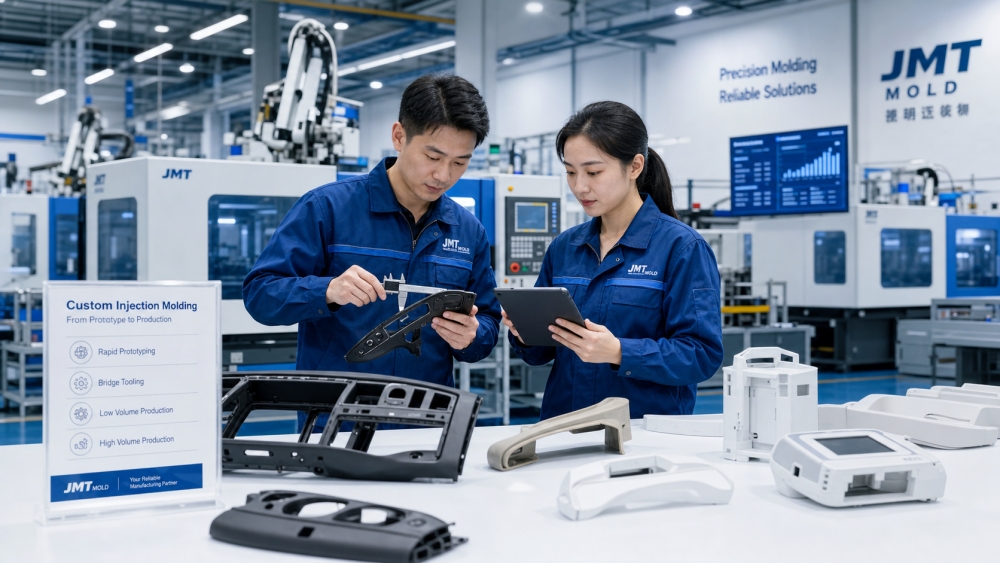
In modern manufacturing strategy, companies must answer three important questions:
- What is bridge tooling in injection molding?
- What is the difference between high volume vs low volume injection molding?
- Can injection molding be used for rapid prototyping?
Choosing the right custom injection molding approach can dramatically reduce development risk, shorten lead time, and optimize total project investment.
Huawei Product Development Industrial Ltd (HWPD), a leading large-size parts mold manufacturer in China with over 30 years of experience, provides integrated solutions including:
- Industrial Design
- Engineering Design Assistance
- Prototype Injection Molds
- Bridge Tooling
- Production Molds
- Injection Molding & OEM Manufacturing
This comprehensive guide explains each concept in depth.
What is bridge tooling in injection molding?
Bridge tooling in custom injection molding refers to an intermediate mold solution used between prototype tooling and full production tooling. It serves as a “bridge” that allows manufacturers to produce low-to-medium volume parts while preparing for long-term mass production tooling.
Why Bridge Tooling Exists in Custom Injection Molding
In product development, there are typically three tooling stages:
- Prototype Injection Mold
- Bridge Tooling (Rapid Mold / Aluminum Mold / Soft Tool)
- Production Mold (Hardened Steel Tooling)
Bridge tooling is especially useful when:
- The product design has been validated
- Market testing requires several thousand parts
- Full production mold lead time is too long
- Investment risk must be controlled
- Demand forecast is still uncertain
Bridge tooling provides a cost-effective transition strategy.
Characteristics of Bridge Tooling in Custom Injection Molding
| Feature | Bridge Tooling | Prototype Mold | Production Mold |
|---|---|---|---|
| Tool Material | Aluminum or pre-hardened steel | Aluminum or soft steel | Hardened steel |
| Production Volume | Low to Medium | Very low | High / Mass production |
| Tooling Cost | Medium | Low | High |
| Lead Time | Moderate | Short | Long |
| Durability | Medium lifespan | Short lifespan | Long lifespan |
| Risk Level | Controlled | Very low | Higher initial investment |
Bridge tooling is commonly used for:
- Market launch batches
- Small-scale commercial supply
- Customer feedback collection
- Early revenue generation
- Supply continuity before full tooling completion
How HWPD Supports Bridge Tooling Projects
At Huawei Product Development Industrial Ltd, we manufacture:
- Prototype injection molds for R&D validation
- Aluminum molds and bridge molds for small-volume production
- Full production molds for large-scale manufacturing
For newly developed products, many of our clients first build a prototype injection mold to verify:
- Plastic part design
- Resin flowability
- Injection stability
- Functional performance
- Mold structural integrity
After design validation, they upgrade to bridge tooling before final production molds.
This staged approach:
- Reduces overall development cost
- Minimizes tooling waste
- Accelerates time-to-market
- Improves product reliability
High volume vs low volume injection molding
Understanding the difference between high volume and low volume custom injection molding is essential for selecting the right tooling strategy and production plan.
What is Low Volume Injection Molding?
Low volume injection molding typically refers to production runs ranging from a few hundred to tens of thousands of parts.
It is commonly used for:
- Product development testing
- Market validation
- Limited edition products
- Medical devices
- Industrial equipment components
- Specialized automotive parts
Advantages of Low Volume Injection Molding
- Lower upfront investment
- Faster production startup
- Design flexibility
- Reduced financial risk
- Ideal for new product launch
Low volume production often uses:
- Prototype molds
- Aluminum molds
- Bridge tooling
What is High Volume Injection Molding?
High volume injection molding refers to large-scale production runs of hundreds of thousands to millions of parts.
It is ideal for:
- Mature and stable products
- Automotive components
- Consumer electronics housings
- Medical device enclosures
- Industrial equipment parts
Advantages of High Volume Injection Molding
- Lower cost per part
- High consistency
- Long tool life
- Automated manufacturing efficiency
- Stable supply chain
High volume production requires hardened steel production molds designed for durability and precision.
High Volume vs Low Volume Injection Molding Comparison Table
| Factor | Low Volume Injection Molding | High Volume Injection Molding |
|---|---|---|
| Tooling Cost | Lower | Higher |
| Unit Cost | Higher per part | Lower per part |
| Production Speed | Moderate | Very high |
| Flexibility | High | Lower |
| Risk Level | Lower | Higher upfront |
| Tool Life | Short to Medium | Long |
| Suitable Industries | Medical, R&D, niche markets | Automotive, electronics, consumer goods |
Choosing the Right Volume Strategy in Custom Injection Molding
The right strategy depends on product maturity, demand forecast, budget constraints, lifecycle stage, and timeline.
At HWPD, we provide professional recommendations based on each customer's product development stage:
- R&D Testing → Prototype Injection Mold
- Market Validation → Bridge Tooling
- Mature Product → Production Mold
Can injection molding be used for rapid prototyping?
Yes — custom injection molding can absolutely be used for rapid prototyping, especially when high precision and real production materials are required.
Why Injection Molding is Ideal for Rapid Prototyping
- Real injection molding material properties
- Resin flow characteristics
- Structural performance under production conditions
- Surface finish identical to final product
Injection molded prototypes allow:
- True material testing
- Functional testing
- Assembly validation
- Stress testing
- Dimensional verification
Advantages of Injection Molded Prototypes
- Quality level similar with traditional mold
- Same plastic materials as mass production
- Save overall development cost
- Test and verification of plastic parts design
- Test and verification of mold design
- Test and verification of resin flowability
- Test and verification of function
- Launch new product quickly at short lead time
Comparing Rapid Prototyping Methods
| Method | Material Accuracy | Production Simulation | Cost | Lead Time |
|---|---|---|---|---|
| 3D Printing | Limited | No | Low | Very fast |
| CNC Machining | Medium | No | Medium | Fast |
| Vacuum Casting | Medium | Partial | Medium | Moderate |
| Injection Molded Prototype | High | Yes | Medium | Fast |
Integrated Custom Injection Molding Solutions at HWPD
1. Product Development & Prototyping
- Engineering Design Assistance
- Industrial Design
- 3D Printed Prototypes
- CNC Machined Prototypes
- Vacuum Casted Prototypes
- High-Precision Plastic Injection Prototypes
2. Plastic Injection Mold Manufacturing
- Mold Design
- DFM & Mold Flow Analysis
- Prototype Injection Mold
- Aluminum / Bridge Mold
- Production Mold
- Over-molding
- Two-color molding
- IMD / IML processes
3. Injection Molding & OEM Manufacturing
- Short, medium, and long production runs
- Automotive structural parts
- Medical device housings
- Industrial precision parts
- AI robotics components
- Large-sized injection molded parts
Industries Served by Our Custom Injection Molding Services
- Automotive (BMW, Volvo, Mercedes-Benz, GM, Ford, Volkswagen, Nissan)
- Medical Equipment
- Aerospace
- Industrial Machinery
- Communication Equipment
- Artificial Intelligence & Robotics
With over 30 years of production experience, our strict QC system includes:
- DFM meeting procedures
- Design Verification & Validation
- Mold processing management system
- Precision inspection
FAQ – Custom Injection Molding
What is bridge tooling in injection molding?
Bridge tooling is an intermediate mold solution used between prototype and full production molds to support low-to-medium volume production before mass manufacturing.
When should I choose low volume injection molding?
Low volume injection molding is ideal for new product launches, market validation, and limited production runs.
Is high volume injection molding cheaper?
High volume injection molding has higher initial tooling cost but lower per-part cost over time.
Can injection molding replace 3D printing for prototyping?
Injection molded prototypes provide more accurate material properties and production simulation compared to 3D printing.
Can prototype molds be upgraded?
Yes. Prototype molds can be modified or upgraded to production molds once design validation is complete.
How do I reduce injection molding risk?
Use staged development: prototype mold → bridge tooling → production mold.
Start Your Custom Injection Molding Project with a Trusted Manufacturing Partner
If you are planning a new product launch or scaling to mass production, choosing the right Custom Injection Molding partner is essential.
Huawei Product Development Industrial Ltd provides:
- Prototype injection molds for rapid validation
- Bridge tooling for controlled market entry
- High-precision production molds for large-scale manufacturing
- OEM injection molding services
- Automotive and medical-grade manufacturing expertise
With over 30 years of experience serving global clients such as BMW, Honda, Panasonic, and other world-class enterprises, we help companies reduce development risk, optimize cost, and accelerate time-to-market.
Contact us today to discuss your Custom Injection Molding project and receive professional engineering recommendations tailored to your product stage.
Phone: +86-755-8238-2595
Mobile: +86-139-2383-5403
Email: admin@huaweiproduct.com
Huawei Product Development Industrial Ltd — Leading Large-Size Parts Mold Manufacturer in China | Full-Link Intelligent Manufacturing Solutions (ID, Prototyping & OEM)