Selecting the right manufacturing process for large plastic parts is one of the most important decisions in product development. Whether you are producing automotive bumpers, industrial tanks, equipment housings, or structural enclosures, the process you choose will directly impact tooling cost, per-unit price, mechanical performance, scalability, and long-term profitability.
Among the most commonly compared processes are:
Each of these plastic forming technologies serves a different purpose. Some excel in high-volume precision production, while others are optimized for hollow structures, low tooling costs, or oversized geometries.
This comprehensive guide breaks down each process in technical detail, compares cost structures, mechanical properties, and scalability, and provides a practical decision framework grounded in real manufacturing experience.
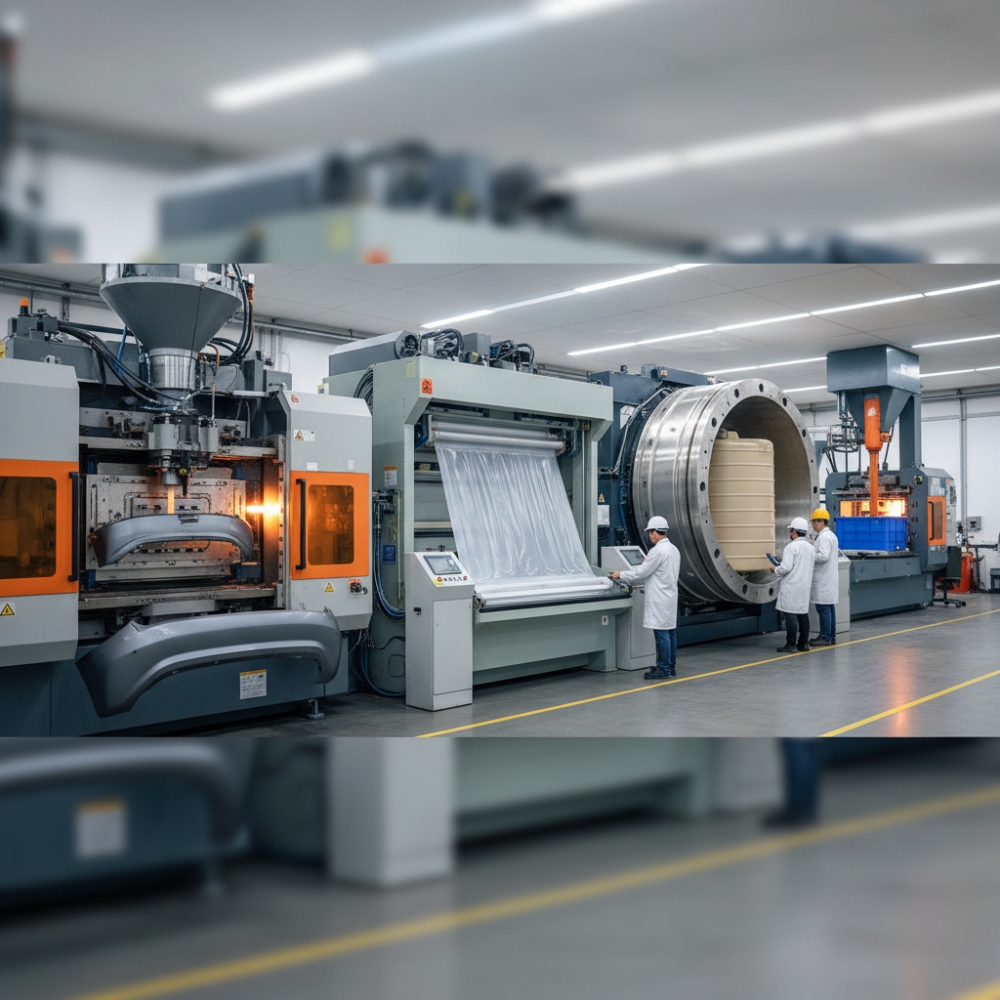
Before comparing injection molding vs thermoforming or rotational molding vs injection molding, we must define what qualifies as a “large plastic part.”
In industrial manufacturing, a large plastic part is generally defined by one or more of the following criteria:
However, different industries use different benchmarks.
| Category | Typical Size Range | Common Manufacturing Processes |
|---|---|---|
| Small | < 300 mm | Injection molding |
| Medium | 300–800 mm | Injection molding, Thermoforming |
| Large | 800 mm – 2 meters | Thermoforming, Rotational molding |
| Extra Large | > 2 meters | Rotational molding, Blow molding |
Large parts often introduce unique challenges:
Because of these factors, not every plastic manufacturing process scales efficiently for large parts.
One of the most common comparisons in industrial manufacturing is Injection molding vs thermoforming for large parts.
Although both processes can produce large plastic components, they differ significantly in tooling structure, cost model, mechanical performance, and production scalability.
Injection molding works by injecting molten thermoplastic under high pressure into a closed steel mold cavity. The material solidifies under controlled cooling, producing a dense, dimensionally accurate part.
Key characteristics:
Thermoforming involves heating a plastic sheet until pliable and forming it over or into a mold using vacuum or pressure. After cooling, the formed sheet is trimmed into its final shape.
Key characteristics:
| Factor | Injection Molding | Thermoforming |
|---|---|---|
| Mold Material | Hardened steel | Aluminum / Composite |
| Tooling Complexity | High | Moderate |
| Typical Tooling Cost (Large Part) | $80,000 – $500,000+ | $15,000 – $100,000 |
| Lead Time | 8–16 weeks | 4–8 weeks |
| Mold Lifespan | 500,000+ cycles | 50,000–200,000 cycles |
Injection molded parts offer high density, uniform material distribution, rib reinforcement capability, high impact resistance, and tight dimensional tolerances.
Thermoformed parts typically have thinner wall sections, potential thickness variation, and lower structural stiffness.
| Annual Volume | Injection Molding | Thermoforming |
|---|---|---|
| 500 units | Not economical | Ideal |
| 5,000 units | Marginal | Good |
| 20,000 units | Strong case | Competitive |
| 100,000+ units | Excellent | Less efficient |
Many engineers search specifically for: Vacuum forming vs injection molding cost comparison.
| Cost Element | Vacuum Forming | Injection Molding |
|---|---|---|
| Mold Material | Aluminum, wood, composite | Hardened steel |
| Tooling Cost (Large Part) | $10,000 – $60,000 | $80,000 – $500,000+ |
| Tool Fabrication Time | 3–6 weeks | 8–16 weeks |
| Production Volume | Vacuum Forming Unit Cost | Injection Molding Unit Cost |
|---|---|---|
| 500 | Lower | Higher |
| 5,000 | Competitive | Competitive |
| 50,000 | Higher | Much Lower |
| 200,000 | High | Extremely Low |
The break-even point typically occurs when total injection molding cost equals total vacuum forming cost. Because injection molding spreads tooling cost across more units, it becomes more economical somewhere between 5,000–20,000 units depending on part complexity and material.
Injection molding supports textured mold surfaces, Class A finishes, multi-material overmolding, and complex internal geometry. Vacuum forming is limited by sheet thickness, draft requirements, and trimming dependency.
Injection molding offers full automation, short cycle times, robotics integration, and high repeatability. Vacuum forming often involves semi-automation and higher manual labor input.