2026-04-12
Custom Injection Molding is not just about manufacturing plastic parts — it is a highly engineered process that integrates product design, material science, mold development, and flow optimization. Without proper design guidelines and engineering validation, even a well-built mold can produce unstable or defective parts.
For industries such as automotive, medical devices, industrial precision equipment, and AI robotics, failure is not an option. That is why understanding injection molding design guidelines, DFM (Design for Manufacturability), mold flow analysis, and warpage control is essential.
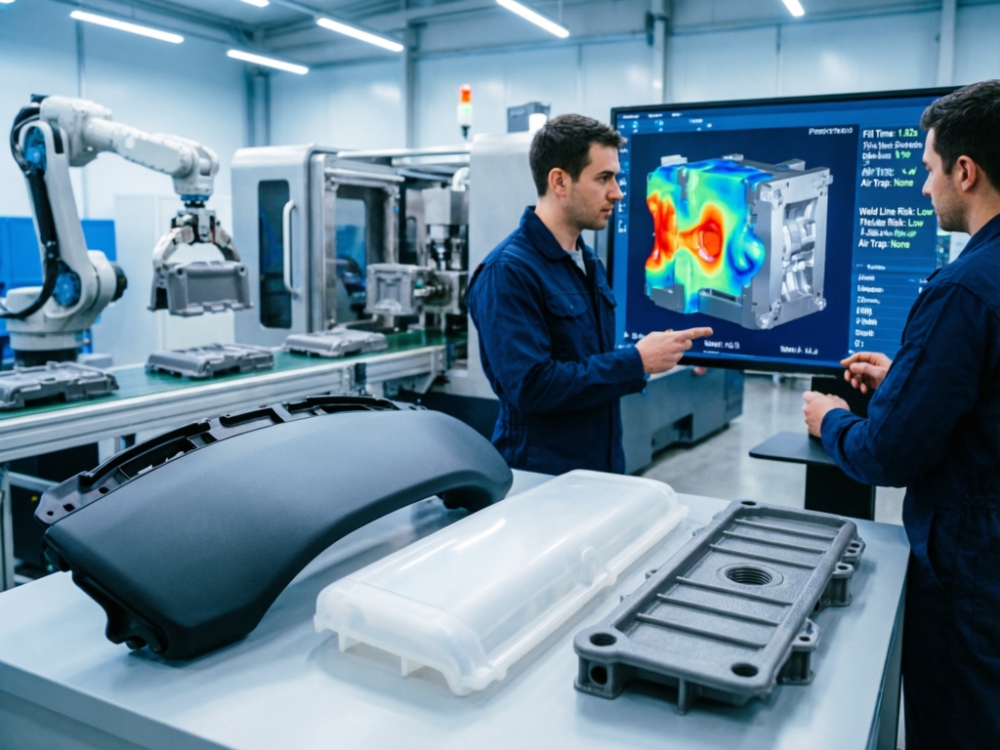
In this comprehensive guide, we will answer the following key questions:
Injection molding design guidelines are engineering principles used to ensure that plastic parts can be manufactured efficiently, consistently, and cost-effectively.
Poor design leads to:
One of the most important principles in Custom Injection Molding is maintaining uniform wall thickness.
| Issue | Result |
|---|---|
| Thick-to-thin transition | Sink marks |
| Uneven cooling | Warpage |
| Thick ribs | Internal stress |
Best Practice: Maintain consistent wall thickness and use ribs for reinforcement instead of increasing thickness.
Draft angles allow parts to be ejected smoothly from the mold.
Recommended draft angles:
Without proper draft angles, parts may stick, causing scratches or deformation.
Ribs improve strength without increasing material consumption.
Guidelines:
Gate placement affects:
Early engineering review prevents costly mold modifications later.
Tight tolerances increase tooling complexity and cost. High-precision industries such as automotive structural parts and medical housings require optimized tolerance control.
Huawei Product Development specializes in high-precision automotive structural parts and medical equipment housings, ensuring design compliance before mold fabrication begins.
DFM stands for Design for Manufacturability.
In Custom Injection Molding, DFM is a structured engineering review process that evaluates whether a part design can be produced efficiently using injection molding technology.
| DFM Evaluation Area | Description |
|---|---|
| Wall thickness analysis | Identify uneven sections |
| Draft angle verification | Ensure proper ejection |
| Gate location proposal | Optimize flow pattern |
| Undercut analysis | Evaluate mold complexity |
| Cooling system suggestion | Improve cycle time |
| Material selection review | Confirm resin compatibility |
Huawei Product Development follows a strict DFM meeting procedure and Design Verification & Validation process to guarantee high-precision mold processing and on-time delivery.
Many clients first choose prototype injection molds to validate:
Prototype molds offer:
After validation, the prototype mold can be upgraded to a production mold, significantly reducing risk.
Warpage is one of the most common defects in Custom Injection Molding. It occurs when uneven shrinkage causes part deformation.
Balanced shrinkage reduces deformation risk.
Cooling channel layout must ensure:
| Material | Warpage Risk Level |
|---|---|
| PP | Medium |
| ABS | Low |
| Nylon | High (due to moisture absorption) |
| PC | Low |
Simulation helps predict shrinkage and deformation before mold cutting.
Huawei Product Development integrates mold flow analysis during design stage to minimize risk, especially for large automotive components such as bumpers, instrument panels, and HVAC housings.
Mold flow refers to how molten plastic fills the cavity during injection.
Poor flow can cause:
Gate type and location determine flow balance.
Common gate types:
Higher temperature improves flowability but must not degrade resin.
Trapped air prevents full filling. Proper venting ensures smooth cavity filling.
Manufacturers provide high-flow variants for thin-wall applications.
Balanced runner systems reduce pressure loss and improve consistency.
Huawei Product Development performs DFM and mold flow validation before production mold fabrication, ensuring efficient filling even for medium and large-sized injection-molded parts.
Mold flow analysis is a computer simulation technology used to predict how molten plastic will behave during injection molding.
It allows engineers to visualize:
| Benefit | Impact |
|---|---|
| Reduce mold modification | Save cost |
| Improve first-shot success rate | Shorten development time |
| Optimize gate location | Improve aesthetics |
| Predict warpage | Improve dimensional accuracy |
| Improve cycle time | Increase productivity |
For large-size automotive parts such as:
Flow imbalance can cause severe deformation. Simulation ensures structural stability before mold cutting.
Huawei Product Development has over 30 years of experience in:
Our services include:
We serve global customers including well-known automotive brands.
Uniform wall thickness and proper draft angle are the most critical factors.
DFM prevents costly mold redesign and ensures manufacturability before production.
Yes. It predicts shrinkage and deformation before mold manufacturing begins.
It is highly recommended for new product development to reduce risk and validate material performance.
Through strict QC systems, DFM meetings, Design Verification & Validation procedures, and advanced mold processing management.
Huawei Product Development Industrial Ltd is your reliable partner in product design, prototype, and mold processing.
Our advantages:
If you are looking for a professional Custom Injection Molding manufacturer with strong engineering capabilities in DFM, mold flow analysis, and warpage control, Huawei Product Development is ready to support your project.
Whether you need:
Our experienced engineering team will help optimize your design, reduce risk, and accelerate time-to-market.
Contact us today:
Email: admin@huaweiproduct.com
Phone: +86-755-8238-2595
Let Huawei Product Development turn your design into high-performance custom injection molded products with precision, reliability, and efficiency.