

Custom Injection Molding Guide: Defects, Sink Marks, Thin Wall, Insert Molding & Overmolding
Custom Injection Molding is one of the most advanced and widely used manufacturing processes for producing precision plastic components across automotive, medical, industrial, aerospace, and AI industries. However, achieving high-quality injection molded parts requires not only precision mold manufacturing but also deep engineering knowledge of defect control, wall thickness optimization, advanced molding technologies, and structural integration methods.
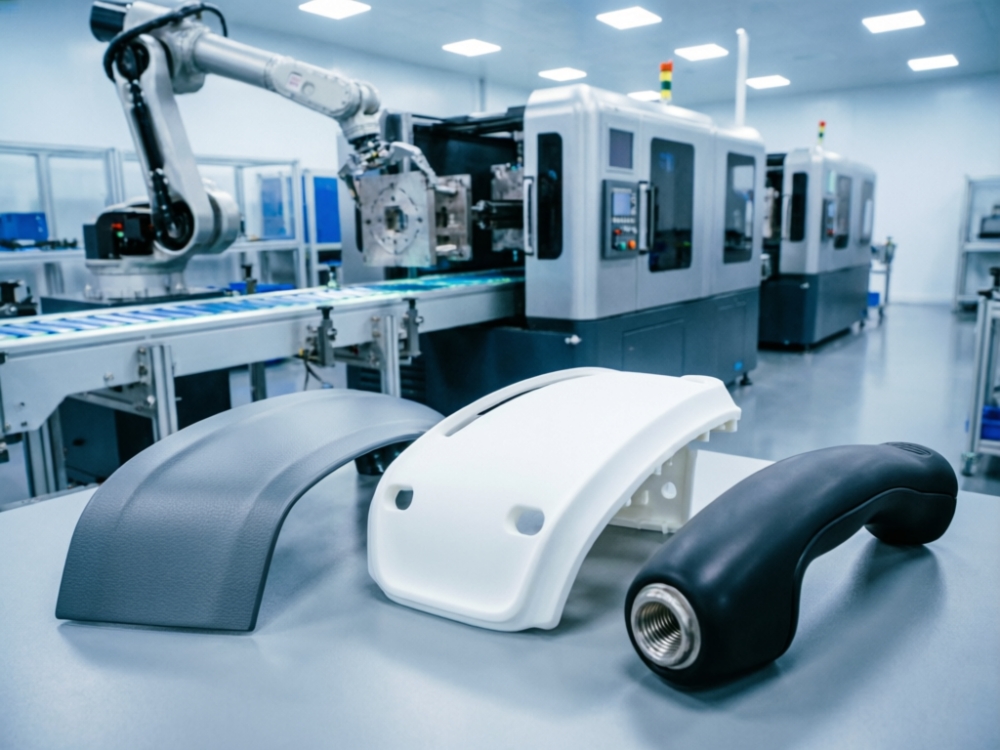
Many injection molding failures are not caused by machine issues but by design flaws, material misselection, improper mold engineering, or lack of early-stage validation.
In this comprehensive Custom Injection Molding guide, we will answer the following key questions:
- What causes defects in injection molding?
- How to prevent sink marks in injection molding?
- What is thin wall injection molding?
- What is insert molding?
- What is overmolding?
What causes defects in injection molding?
Defects in Custom Injection Molding can arise from multiple factors, including material behavior, mold design, machine settings, and cooling imbalance.
Understanding defect causes is critical before launching mass production.
Common Injection Molding Defects
| Defect | Description | Main Cause |
|---|---|---|
| Sink Marks | Surface depressions | Uneven wall thickness |
| Warpage | Part deformation | Uneven cooling |
| Short Shot | Incomplete filling | Poor flow or low pressure |
| Flash | Excess material at edges | Mold misalignment |
| Weld Lines | Visible lines at flow meeting points | Improper gate design |
| Burn Marks | Dark discoloration | Trapped air |
| Bubbles | Internal voids | Poor venting or moisture |
Root Causes of Injection Molding Defects
1. Poor Part Design
Improper wall thickness transitions and lack of draft angles are major contributors to defects.
2. Incorrect Material Selection
Some materials shrink more than others. Nylon, for example, absorbs moisture and may warp if not processed correctly.
3. Mold Design Issues
Gate location, runner balance, cooling channel layout, and venting design directly impact part quality.
4. Process Parameter Instability
Injection pressure, mold temperature, holding time, and cooling duration must be precisely controlled.
The Importance of Prototype Validation
Huawei Product Development recommends using prototype injection molds during R&D testing to:
- Verify resin flowability
- Test injection stability
- Validate part design
- Identify defect risks early
- Reduce production waste
Our prototype injection molds maintain the same accuracy as production molds, allowing customers to test real mass-production materials before committing to full-scale tooling.
How to prevent sink marks in injection molding?
Sink marks are one of the most common surface defects in Custom Injection Molding. They appear as small depressions on thicker sections of a plastic part.
Why Sink Marks Occur
When thick sections cool, the outer surface solidifies first while the internal material continues to shrink. Without adequate packing pressure, the surface collapses inward.
Engineering Methods to Prevent Sink Marks
1. Maintain Uniform Wall Thickness
Avoid thick-to-thin transitions and replace thick sections with rib structures.
2. Optimize Rib Design
| Design Parameter | Recommendation |
|---|---|
| Rib thickness | 50–60% of wall thickness |
| Rib height | ≤ 3× wall thickness |
| Add fillet | Reduce stress concentration |
3. Increase Packing Pressure and Holding Time
Proper packing compensates for shrinkage during cooling.
4. Improve Gate Location
Gate should be located near thick areas to ensure adequate packing.
5. Use Mold Flow Analysis
Simulation software predicts sink mark risk before mold manufacturing begins.
Huawei Product Development integrates DFM review and mold flow analysis to prevent sink marks, especially in automotive structural components and medical housings requiring premium surface finish.
What is thin wall injection molding?
Thin wall injection molding is a specialized Custom Injection Molding process used to manufacture plastic parts with extremely thin wall sections—typically less than 1.5 mm.
It is widely used in:
- Automotive interior panels
- Electronic housings
- Medical device casings
- Smart device covers
Challenges of Thin Wall Injection Molding
| Challenge | Description |
|---|---|
| High flow resistance | Molten plastic must travel quickly |
| Fast cooling | Risk of short shots |
| High injection pressure | Increased machine demand |
| Tight tolerance | Dimensional accuracy critical |
Key Requirements for Thin Wall Injection Molding
- High-speed injection machines
- Optimized gate design
- High-flow resin materials
- Precise mold temperature control
- Balanced runner system
Why Thin Wall Molding is Important for Automotive & Medical
Thin wall designs reduce vehicle weight, improve fuel efficiency, lower material cost, and improve aesthetic appearance.
Huawei Product Development specializes in medium and large-sized injection molded parts for automotive interior panels, bumpers, HVAC systems, and medical device housings. Our engineering team ensures structural integrity even under thin wall conditions.
What is insert molding?
Insert molding is a type of Custom Injection Molding process where metal or other components are inserted into the mold before plastic injection. The plastic material then encapsulates the insert.
Applications of Insert Molding
- Electrical connectors
- Medical equipment components
- Automotive sensor housings
- Threaded brass inserts
Advantages of Insert Molding
| Benefit | Explanation |
|---|---|
| Reduced assembly cost | Eliminate secondary operations |
| Improved structural strength | Strong bonding |
| Enhanced durability | Combined material properties |
| Better precision | One-step molding |
Insert Molding vs Traditional Assembly
Traditional assembly requires multiple steps, screws or adhesives, and higher labor cost. Insert molding integrates components in a single process.
Huawei Product Development supports high-precision insert molding solutions for industrial equipment and medical communication instruments.
What is overmolding?
Overmolding is a Custom Injection Molding process where one material is molded over another material to create a multi-material component.
It differs from insert molding because insert molding uses pre-placed components (often metal), while overmolding typically bonds two plastics.
Common Overmolding Applications
- Soft-touch handles
- Automotive control buttons
- Medical grips
- Electronic device housings
Benefits of Overmolding
| Benefit | Description |
|---|---|
| Improved ergonomics | Soft-touch surfaces |
| Enhanced durability | Shock absorption |
| Waterproof sealing | Improved protection |
| Reduced assembly steps | Integrated manufacturing |
Two-Color and Advanced Molding Technologies
Huawei Product Development offers overmolding, two-color molding, In-Mold Decoration (IMD), and In-Mold Labelling (IML). These technologies allow manufacturers to integrate function and aesthetics in a single molding cycle.
The Role of Prototype Injection Molds in Advanced Custom Injection Molding
For new product development, prototype injection molds allow testing of thin wall flow behavior, validation of insert bonding strength, overmolding adhesion testing, resin compatibility verification, and functional validation.
Advantages include same material as production, same precision level, short lead time, lower cost, and faster market launch. After validation, molds can be upgraded to mass production molds.
Custom Injection Molding for Automotive & Medical Industries
Huawei Product Development has over 30 years of experience in automotive structural molds, door panels, bumpers and grilles, HVAC systems, engine peripheral components, medical device housings, industrial precision parts, and AI robotics components.
We provide engineering design assistance, industrial design, prototype injection mold manufacturing, production mold fabrication, and OEM injection molding manufacturing.
Our strict QC system, DFM meeting procedures, and Design Verification & Validation process guarantee high precision and reliable delivery.
FAQ – Custom Injection Molding Defects & Advanced Processes
What is the most common defect in injection molding?
Sink marks and warpage are among the most common defects.
How can sink marks be prevented?
Maintain uniform wall thickness, optimize rib design, and increase packing pressure.
Is thin wall injection molding more expensive?
It requires higher precision and advanced equipment, but reduces material cost.
What is the difference between insert molding and overmolding?
Insert molding encapsulates pre-placed components (often metal), while overmolding bonds multiple plastic materials.
Why is prototype injection molding important?
It validates design, flow, and function before committing to mass production, reducing risk and development cost.
Why Choose Huawei Product Development for Custom Injection Molding?
Huawei Product Development Industrial Ltd is your reliable partner in product design, prototyping, and mold processing.
- Prototype injection molds
- Rapid molds and bridge molds
- Production molds for large-scale manufacturing
- Automotive structural mold expertise
- Medical precision mold capability
- Insert molding and overmolding solutions
- OEM injection molding services
Our advantages include 30+ years of experience, high-precision mold manufacturing, short lead time, competitive cost, strict QC system, and full-link intelligent manufacturing solutions.
Start Your Custom Injection Molding Project Today
If you are looking for a professional Custom Injection Molding manufacturer with strong expertise in defect control, thin wall molding, insert molding, and overmolding technologies, Huawei Product Development is ready to support your project.
Whether you need prototype injection molds for R&D validation, high-precision production molds, automotive structural components, medical device housings, or OEM injection molded parts, our engineering team will help you optimize design, prevent defects, reduce development risk, and accelerate time-to-market.
Contact us today:
Email: admin@huaweiproduct.com
Phone: +86-755-8238-2595
Let Huawei Product Development transform your product concept into high-performance custom injection molded solutions with precision, reliability, and efficiency.