2026-03-25
Injection molding is one of the most critical and widely utilized manufacturing processes in the modern industrial landscape. From producing high-precision automotive parts to intricate components used in medical, OA and communication equipment, etc, injection molding offers unmatched scalability, repeatability, and cost-effectiveness for mass production. However, mastering this complex process requires a deep understanding of material science, thermodynamics, and mechanical engineering.
For manufacturers and product developers, the ultimate goals are always the same: reduce costs, increase output, and maintain flawless quality. Achieving these goals means you must know how to optimize your machinery, design perfect molds, and quickly resolve any issues that arise on the production floor.
In this comprehensive guide, we will dive deep into the world of plastic manufacturing. We will explore exactly how to reduce cycle time in injection molding, how to improve overall injection molding efficiency, and what the most common injection molding defects are. Furthermore, we will provide a detailed injection molding troubleshooting guide to help you overcome production hurdles. Finally, we will explain how partnering with a leading expert like Huawei Product Development Industrial Ltd (HWPD) and utilizing prototype injection molds can save you time, reduce development costs, and guarantee a successful product launch.
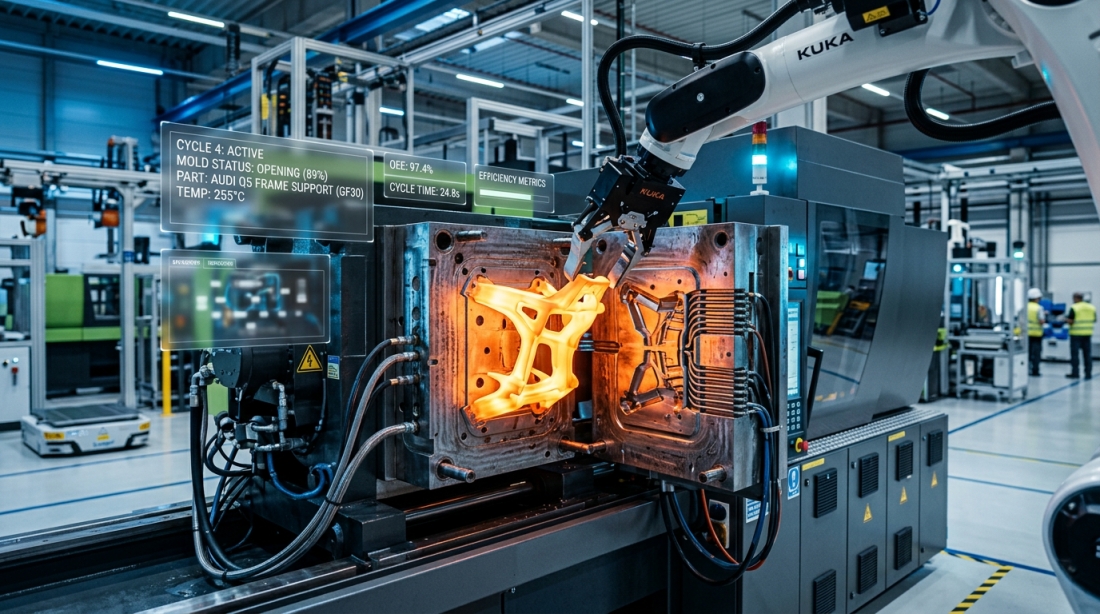
In the highly competitive world of injection molding, time is literally money. The "cycle time" refers to the total time required to complete one full cycle of the injection molding process—from the moment the mold closes to the moment the finished part is ejected. Even a reduction of a fraction of a second per cycle can translate to massive cost savings and increased profit margins over a production run of hundreds of thousands of parts.
To understand how to reduce cycle time in injection molding, we must first break down the cycle into its core components: injection time, cooling time, and ejection time. Cooling time typically accounts for the largest portion of the cycle (often up to 70%). Therefore, optimizing cooling is usually the most effective way to speed up the process.
The design of the cooling channels within the injection mold is paramount. Traditional cooling channels are drilled in straight lines, which can leave certain areas of the mold hotter than others, requiring longer overall cooling times to ensure the thickest parts of the plastic solidify.
The thicker the plastic, the longer it takes to cool. During the Design for Manufacturability (DFM) phase, engineers should strive to design parts with the thinnest possible walls that still meet the structural and functional requirements of the product. Furthermore, maintaining a uniform wall thickness throughout the part prevents uneven cooling, which not only reduces cycle time but also prevents common injection molding defects like warping and sink marks.
Different plastic resins have different thermal properties and melt flow indexes. Some materials cool and solidify much faster than others. If your product's application allows for flexibility in material choice, selecting a resin with a faster cooling rate or higher flowability can naturally shave seconds off your cycle time.
Proper calibration of the injection molding machine is crucial.
While reducing cycle time is a massive part of the equation, overall injection molding efficiency encompasses much more. Efficiency means maximizing machine uptime, minimizing scrap and waste, reducing energy consumption, and streamlining the transition from product design to mass production.
The foundation of injection molding efficiency is laid long before plastic ever enters a machine. DFM is the process of designing a product specifically so that it is easy and cost-effective to manufacture. At HWPD, our engineering team conducts rigorous DFM analysis on every project. By identifying potential manufacturing bottlenecks—such as undercuts that require complex mold actions, or areas prone to air traps—we can modify the design early. This prevents costly mold modifications and production delays later on.
One of the most effective strategies to improve long-term injection molding efficiency is the use of prototype injection molds. Jumping straight into a hardened steel mass-production mold is risky. If the design is flawed, modifying a production mold is incredibly expensive and time-consuming.
Integrating robotics into the injection molding process drastically improves efficiency. Robots can be used for part extraction, trimming runners, inserting metal components (for insert molding), and packaging. Automation ensures consistent cycle times, reduces human error, and allows the injection molding machines to run continuously, 24/7, with minimal supervision.
An injection molding machine that breaks down mid-production destroys efficiency. Implementing a strict preventative maintenance schedule for both the machines and the molds is essential. Molds must be regularly cleaned, lubricated, and inspected for wear and tear. Modern facilities also use predictive maintenance sensors to monitor machine vibrations, temperatures, and pressures, alerting operators to potential failures before they happen.
Even with optimized cycle times and high efficiency, the physical realities of melting, injecting, and cooling plastic can lead to cosmetic or structural flaws. Understanding "what is common injection molding defects" is the first step toward preventing them. Here are the most frequent issues encountered in the injection molding process:
Warping occurs when different parts of the molded component shrink at different rates during the cooling process. This uneven internal stress causes the final part to twist, bend, or bow out of its intended shape. It is most commonly caused by uneven cooling channel design, inconsistent wall thickness, or incorrect mold temperatures.
A short shot is exactly what it sounds like: the molten plastic fails to completely fill the mold cavity, resulting in an incomplete part with missing edges or details. This is usually caused by insufficient injection pressure, low injection speed, low melt temperature, or trapped air inside the mold that creates back-pressure.
Sink marks are shallow depressions or dimples that appear on the flat surfaces of an injection molded part. They typically occur above thicker sections of the part, such as internal ribs or bosses. As the thick inner core of the plastic cools and shrinks, it pulls the already-solidified outer skin inward, creating a sink mark.
Bubbles are empty spaces trapped within the walls of the plastic part. Vacuum voids are caused by the same shrinkage phenomenon as sink marks, but the outer skin is strong enough to resist pulling inward, causing a void to form inside instead. Gas pockets are caused by trapped air in the mold or moisture in the plastic resin that turns to steam when heated.
Flash is a thin lip or protrusion of excess plastic that escapes the mold cavity and forms along the parting line (where the two halves of the mold meet) or around ejector pins. Flash is typically caused by injection pressure that is too high, clamping force that is too low, or a mold that is worn out or damaged.
Weld lines appear as fine lines or cracks on the surface of the part. They occur where two separate flows of molten plastic meet and fuse together (for example, when plastic flows around a hole in the part). If the plastic is too cold when the flows meet, they will not bond properly, creating a weak point and a visible line.
When defects appear, operators must act quickly to diagnose and resolve the root cause. Below is a comprehensive injection molding troubleshooting guide presented in a quick-reference table to help you maintain peak production quality.
| Injection Molding Defect | Visual Identification | Primary Causes | Troubleshooting Solutions |
|---|---|---|---|
| Warping | Part is twisted, bent, or distorted out of shape. | Uneven cooling, inconsistent wall thickness, high internal stress. | Optimize cooling time/temperature; redesign part for uniform wall thickness; adjust hold pressure. |
| Short Shots | Incomplete part; missing extremities or fine details. | Low injection pressure/speed, low melt temperature, poor mold venting. | Increase injection pressure and speed; raise melt/mold temperature; improve mold venting. |
| Sink Marks | Depressions or dimples on the surface, usually over thick areas. | Excessive shrinkage in thick sections, insufficient hold pressure/time. | Reduce thickness of internal ribs (max 60% of main wall); increase hold pressure and time; increase cooling time. |
| Bubbles / Voids | Empty spaces or trapped gas inside the plastic walls. | Trapped air, moisture in resin, uneven shrinkage. | Dry resin thoroughly before molding; improve mold venting; core out thick sections of the part design. |
| Flash | Excess thin plastic along the mold parting line. | Injection pressure too high, clamping force too low, damaged mold. | Decrease injection pressure/speed; increase machine clamping force; inspect and repair mold surfaces. |
| Weld Lines | Visible lines where plastic flows meet; potential weak points. | Low melt temperature, slow injection speed, poor gate location. | Raise melt and mold temperatures; increase injection speed; redesign gate locations to change flow paths. |
At Huawei Product Development Industrial Ltd (HWPD), we are your reliable partner in product design, prototyping, and mold processing. As a medium and large-scale professional mold manufacturing enterprise in China with over 30 years of production experience, we understand the intricacies of the injection molding process better than anyone.
Our mold building services are highly focused on high-precision automotive structural parts (such as door panels, instrument panels, and bumpers) and high-precision parts used in the equipment or instruments of the medical and communication industries. We serve well-known global enterprises, including Panasonic, Honda, Toyota, BMW, Mercedes-Benz, Volkswagen, and Nissan.
We have rich experience and proprietary know-how to manufacture high-precision prototype molds in a very short lead-time and at a low cost. This capability helps our customers maintain a massive competitive advantage in the fast-paced market.
The advantages of utilizing HWPD's injection molded prototypes include:
Whether you need a bridge mold for small-volume production or a multi-cavity hardened steel mold for high-volume OEM product manufacturing, HWPD provides full-link intelligent manufacturing solutions.
To further assist you in understanding the complexities of plastic manufacturing, we have compiled answers to some of the most frequently asked questions regarding injection molding.
A prototype injection mold is typically made from softer metals like aluminum or mild steel. It is designed to be built quickly and cost-effectively to test part design, material flow, and produce small batches for market validation. A production mold is machined from hardened steel, designed to withstand the extreme pressures of millions of cycles for high-volume, long-term mass production.
Different plastics have varying thermal conductivities and melt flow indexes. Semi-crystalline materials (like Nylon) often require different cooling strategies compared to amorphous materials (like ABS). Selecting a resin that flows easily and cools rapidly can significantly reduce the overall cycle time, thereby improving manufacturing efficiency.
While it is nearly impossible to achieve an absolute zero-defect rate over millions of parts, defects can be reduced to negligible levels. This is achieved through rigorous Design for Manufacturability (DFM), utilizing mold flow analysis software, building prototype molds to test designs, and maintaining strict quality control over machine parameters.
HWPD specializes in high-precision, medium to large-sized parts. Our primary applications include the automotive industry (interior and exterior parts), industrial precision machinery, medical equipment housings, aerospace components, and parts for Artificial Intelligence (AI) robots and smart devices.
Navigating the complexities of injection molding—from reducing cycle times and improving efficiency to troubleshooting frustrating defects—requires a partner with deep technical expertise and world-class facilities.
At Huawei Product Development Industrial Ltd (HWPD), we provide end-to-end solutions. Whether you need industrial design assistance, high-precision prototype injection molds to verify your new product, or robust mass-production molds for global distribution, our team of experts is ready to deliver flawless results on time and within budget.
Don't let design flaws or production inefficiencies hold your product back. Contact HWPD today to discuss your project requirements, request a DFM analysis, or get a competitive quote. Let us help you turn your innovative concepts into high-quality, market-ready realities.